


Standard Indonesian Business Field Classifications
The Definition of KBLI
The KBLI serves as the official reference for classifying economic activities in Indonesia that produce products or outputs, whether in the form of goods or services, into specific business fields. KBLI also functions as a standard reference and as a tool for coordination, integration, and synchronization in the implementation of statistical systems. At the end of 2025, BPS officially introduced the updated KBLI through the enactment of BPS Reg. 7/2025. This revision adopts the International Standard Industrial Classification of All Economic Activities (“ISIC”) Revision 5 to ensure the alignment with global standards and accommodating key development such as digital economic transformation, renewable energy activities, and other emerging business models. Moreover, the 2020 KBLI as stipulated in BPS Reg. 2/2020 is no longer compatible with the current developments in Indonesia’s economic activities.
The enactment of BPS Reg. 7/2025 revokes the 2020 KBLI under BPS Reg. 2/2020. Once BPS Reg. 7/2025 takes effect on 18 December 2025, all existing uses of KBLI by each KBLI user must be adjusted to comply with the provisions of BPS Reg. 7/2025 no later than 6 (six) months from the enactment date, which is no later than 18 June 2026.
Based on socialization held by BPS regarding the 2025 KBLI, the types of refinements from the 2020 KBLI to the 2025 KBLI are as follows:
-
Code Split: Introduction of new codes resulting from the splitting of existing codes (one-to-many).
-
Code Merge: Merging of existing codes/scopes into a single new code (many-to-one).
-
Code Title Change: Improvements to wording in titles and nomenclature to clarify the scope of the intended activities.
-
Code Description Change: Improvements to descriptions and nomenclature, addition of examples, and similar adjustments to clarify the scope of the intended activities.
-
Code Transfer: Moving a code for an activity from one subcategory to another.
-
Recoding: Reassigning codes within a subcategory due to changes in its structure, while the title, description, and scope of the recoded code remain unchanged.
-
Scope Consolidation: Merging or combining activity codes or scopes into several existing codes.
-
Code Deletion: Removal of a code or scope from an activity.
The Importance of KBLI
To understand all types of businesses in Indonesia, including its classifications, potential investors can refer to the KBLI as outlined in the Appendix of BPS Reg. No. 2/2020. The KBLI assists prospective investors in determining their intended business activities.
KBLI determines specific code for every business field, which shall be included and listed in the AoA of the company. Moreover, the business actor will choose the main KBLI as a reference in the issuance of its business licensing, which grants the entrepreneur legal permission to start and undertake business and/or activities, which consists of:
-
NIB, which serves as business actor identity and/or business licensing depending on the risk of the relevant business activity;
-
minimum capital and investment value for foreign investment, which sets the investment threshold required for foreign-owned entities;
-
KKPR, which ensures conformity between planned activities and spatial planning regulations;
-
environmental approval, which refers to an environmental eligibility decision or management statement approved by the central or regional government; and
-
PB UMKU, which serves as legal authorization granted to business actors to support the business activity.
The Structure of KBLI
According to BPS, the structure of business field codes under the 2025 KBLI is organized as follows:

Graphic IV.1. The Structure of the KBLI
Source: KBLI 2025 Socialization held by BPS.
For instance, the structure of KBLI 07221 for gold and silver mining is as follows:
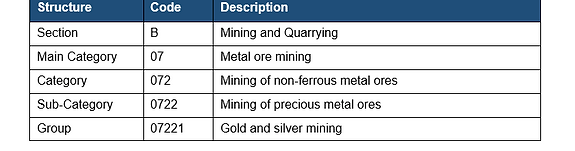
The Structure of KBLI
Source: Launching and Socialization of KBLI 2025 by BPS